

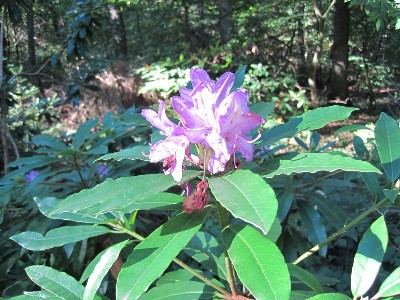
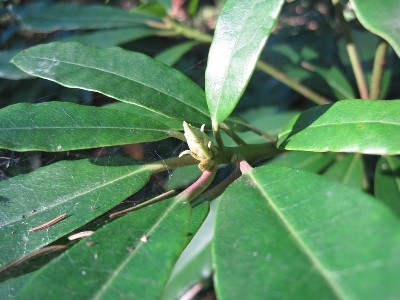
Rhododendron ponticum L. (SE-Eur., SW-As.) – A commonly planted alien, especially near estates, castles and in parks but also in private gardens. Many former plantations are now in nature reserves and other protected areas. Very persistent and extensively suckering, apparently also self-sowing. Now commonly naturalised on sandy, acidic soils, especially in the Kempen and on sandy soils near Brugge (Verloove 2002, De Beer 2006). The invasion history of Rhododendron ponticum is poorly documented in Belgium, probably because it was long considered as a merely planted species. It was first collected in an old park in 1920 in Lippelo (subspontaneous and abundant).
Rhododendron ponticum prefers peaty woodland on acidic, sandy soils. As such, it often grows along with numerous rare and vulnerable native species. Rhododendron ponticum behaves like an invasive exotic in Belgium: as a result of strong clonal growth it spreads fast in natural habitats. Moreover, its leaves are toxic. Similar undesirable behaviour has been reported from several other European countries, especially from the British Isles (see for instance Cross 1982).
Rhododendron ponticum is part of a taxonomically complex species-group (subgenus Hymenanthes; see Chamberlain 1982). Some of the naturalised populations (or perhaps all) probably belong to artificial hybrids involving Rhododendron baeticum Boiss. et Reut. (syn.: R. ponticum subsp. baeticum (Boiss. et Reut.) Hand.-Mazz.), a native from the Iberian Peninsula, and the North American representatives R. catawbiense Michaux, R. maximum L. (Clement & Foster 1994, Milne & Abbott 2000) and possibly also R. macrophyllum D. Don ex G. Don (Stace 2010). According to Cullen (2011) genuine R. ponticum is neither vigorous nor invasive. The invasive plant clearly belongs to a variable hybrid swarm and probably represents a neospecies; it was called R. xsuperponticum Cullen (Cullen l.c.).
 |
 |
Selected literature:
Chamberlain D.F. (1982) A revision of Rhododendron II. Subgenus Hymenanthes. Notes Roy. Bot. Gard. Edinburgh 39: 209-486.
Clement E.J. & Foster M.C. (1994) Alien plants of the British Isles. BSBI, London: XVIII + 590 p.
Cross J.R. (1975) Biological flora of the British Isles: Rhododendron ponticum L. J. Ecol. 63 (1): 345-364.
Cross J.R. (1982) The invasion and impact of Rhododendron ponticum in native Irish vegetation. J. Life. Sci. Roy. Dublin Soc. 3(1): 209-220.
Cullen J. (2011) Naturalised rhododendrons widespread in Great Britain and Ireland. Hanburyana 5: 11-29.
De Beer D. (2006) Rhododendron ponticum. In: Van Landuyt W., Hoste I., Vanhecke L., Van den Bremt P., Vercruysse W. & De Beer D., Atlas van de flora van Vlaanderen en het Brussels gewest. Instituut voor Natuur- en Bosonderzoek, Nationale Plantentuin van België en Flo.Wer: 747.
Milne R.I. & Abbott R.J. (2000) Origin and evolution of invasive naturalised material of Rhododendron ponticum L. in the British Isles. Molecular Ecology 9: 541-556.
Stace C. (2010) New flora of the British Isles, 3th ed.: XXXII + 1232 p. Cambridge University Press.
Verloove F. (2002) Ingeburgerde plantensoorten in Vlaanderen. Mededeling van het Instituut voor Natuurbehoud n° 20: 227 p.