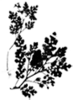

Buddleja davidii Franchet (syn.: B. variabilis Hemsley) (China) – A rather common and much increasing escape from cultivation. Apparently first collected as an escape in the port area of Huy in 1930. From the 1940’s onwards more regularly seen, for instance on rough ground in the surroundings of the former Jardin Botanique in Brussel. Further early records are available from Ciply (abandoned quarry, 1942) and Esneux (rocky slopes, 1946). Already claimed to be naturalized on demolition sites in Tournai in 1954. Furthermore recorded in Bouvignies (abandoned quarry, 1958), Koksijde (ruderalized coastal dunes, 1960), Temse (border of river Schelde, 1952), etc. However, its genuine, wider naturalization is a fairly recent phenomenon and probably started in the 1970’s. Reported as being abundantly naturalized, for instance, on metalliferous soils near Antheit (Wanze) in 1975. From then onwards Buddleja davidii started escaping in large amounts in urban habitats, especially around Antwerpen, Brussel and Gent. Soon afterwards also occurring in many other regions but perhaps less frequent. Van Landuyt (2006) provides a recent distribution map for Flanders. There is a striking difference with the Belgian map published by van Rompaey & Delvosalle (1979). By now Buddleja davidii is still most frequent in highly disturbed, industrial and urban areas but also occurs, for instance, in coastal areas. It is still rare in large parts of the Kempen and Wallonia.
Buddleja davidii is most prolific on stony, sun-exposed, well-drained substrates. Especially in abandoned railway yards and quarries, on coalmine heaps, demolition sites and any rough ground in urban areas it may build nearly monospecific stands. However, it is also found in natural habitats like coastal dunes, calcareous rocks, river borders, etc. In such habitats it is considered to be an undesirable environmental weed. Additional information on its invasive behavior in Belgium is available here: http://ias.biodiversity.be/species/show/44. Its invasiveness has been demonstrated recently in many other regions worldwide. In recent years sterile races have been developed in order to prevent further proliferation of Buddleja davidii into the wild (Hop 2011).
White-flowered plants are often encountered. These are somehow reminiscent of the increasingly cultivated Buddleja fallowiana Balfour et Smith (especially its var. alba Sabourin) (see Sanders 2012). However, in other characters such plants hardly (if at all) differ from Buddleja davidii. They probably represent mere cultivars of the latter (for instance cv ‘White Profusion’ (de Koning & al. 2000) or cv ‘Lochinch’, a putative hybrid of B. davidii and fallowiana.
 |
 |
Selected literature:
Chabot-Jacquety Y. (1986) Croissance, ramification et stratégie adaptative d'un ligneux des terrains vagues: le Buddleia variabilis Hemsl. (Buddleiacées). Bull. Soc. Bot. France, Lett. Bot. 138: 353-362.
Davison A.W. (1997) Is Buddleja davidii expanding in northern Britain? BSBI News 74: 46-47.
De Koning J., Van den Broek J.W., Van de Laar H.J. & Fortgens G. (2000) Nederlandse dendrologie (13e druk). H. Veenman & zonen, Ede: 585 p.
Ebeling S. (2008) Does local adaptation facilitate the success of plant invasions? – A case study on Buddleja davidii. PhD Thesis Martin-Luther-Universität Halle-Wittenberg. [available online at: http://digital.bibliothek.uni-halle.de/hs/content/titleinfo/535982]
Ebeling S.K., Hensen I. & Auge H. (2007) The invasive shrub Buddleja davidii performs better in its introduced range. Diversity and Distributions 14(2): 225-233.
Ebeling S.K., Welk E., Auge H. & Bruelheide H. (2008) Predicting the spread of invasive plant: combining experiments and ecological niche model. Ecography 31(6): 709-719.
Feng Y.L., Auge A. & Ebeling S.K. (2007) Invasive Buddleja davidii allocates more nitrogen to its photosynthetic machinery than five native woody species. Oecologia 153: 501-510.
Fornaciari G. (1967) Insediamento e diffusione de Buddleja davidii Franch. Giorn. Bot. Ital. 101: 281-284.
Hop M.E.C.M. (2006) Buddleja davidii – tussenstand sortimentsonderzoek. Dendroflora 43: 59-64.
Hop M.E.C.M. (2011) Buddleja davidii en hybriden. Sortimentsonderzoek en keuringsrapport. Dendroflora 48: 34-67.
Humphries R.N. & Guarino L. (1987) Soil nitrogen and the growth of birch and buddleja in abandoned chalk quarries. Reclam. Reveg. Res. 6: 55-61.
Jogan N. (2018) When did Buddleja davidii become invasive in Slovenia? Natura Sloveniae 20(1): 5-17. [available online at: http://web.bf.uni-lj.si/bi/NATURA-SLOVENIAE/pdf/NatSlo_20_1_1.pdf]
Kent D.H. (1967) Buddleia, The Butterfly Bush. Wildlife Countryside 266: 9-10.
Kriticos D.J.,Watt M.S., Potter K.J.B., Manning L., Alexander N.S. & Tallent-Halsell N. (2011) Managing invasive weeds under climate change: considering the current and potential future distribution of Buddleja davidii. Weed Research 51(1): 85-96.
Lousley J.E. (1962) Buddleja davidii Franch. Bot. Soc. Brit. Isles Proc. 4(4): 416-417.
Miller A. (1984) The Distribution and Ecology of Buddleia davidii Franch. in Britain, with Particular Reference to Conditions Supporting Germination and the Establishment of Seedlings. PhD thesis, Oxford University: 286 p.
Müller N. (1987) Ailanthus altissima (Miller) Swingle und Buddleja davidii Franchet - zwei adventive Gehoelze in Augsburg. Berichte der Bayerischen Botanischen Gesellschaft 58: 105-107.
Owen D.F. & Whiteway W.R. (1980) Buddleia davidii in Britain: history and development of an associated fauna. Biol. Conservation 17: 149-155.
Pedrotti F. & Gafta D. (1991) Sulla presenza di Buddleja davidii Franchet presso Trento. Inform. Bot. Ital. 22(3): 197-198.
Pfeiffenschneider M., Gräser P. & Ries C. (2014) Distribution of selected neophytes along the national railway network of Luxembourg. Bulletin de la Société des naturalistes Luxembourgeois 115: 95-100. [available online at: http://www.snl.lu/publications/bulletin/SNL_2014_115_095_100.pdf]
Pfeiffenschneider M., Gräser P. & Ries C. (2014) Distribution of selected neophytes along the main rivers of Luxembourg. Bulletin de la Société des naturalists Luxembourgeois 115: 101-108. [available online at: http://www.snl.lu/publications/bulletin/SNL_2014_115_101_108.pdf]
Sanders C. (2012) The air’s buzzing with buddleias. The Garden 9/2012: 56-60.
Smale M.C. (1990) Ecological role of Buddleia (Buddleja davidii) in streambeds in the Urewera National Park. New Zealand J. Ecol. 14: 1-6.
Tallent-Hasell N.G. & Watt M.S. (2009) The Invasive Buddleja davidii (Butterfly Bush). Bot. Rev. 75: 292-325. [available online at: http://link.springer.com/article/10.1007%2Fs12229-009-9033-0?LI=true#]
Thompson R.L. & Abbott R. (2013) History, dispersal, and distribution of Buddleja davidii (Scrophulariaceae) in Kentucky. J. Bot. Res. Inst. Texas 7(1): 495-505. [available online at: http://brit.org/webfm_send/327]
Thompson R.L.& Thomspon K.R. (2015) Buddleja davidii (Scrophulariaceae) naturalized populations in Tennessee (U.S.A.) and its woody associates. Journal of the Botanical Research Institute of Texas 9(1): 213-227. [available online at: http://brit.org/webfm_send/1419]
Van Landuyt W. (2006) Buddleja davidii. In: Van Landuyt W., Hoste I., Vanhecke L., Van den Bremt P., Vercruysse W. & De Beer D., Atlas van de flora van Vlaanderen en het Brussels gewest. Instituut voor Natuur- en Bosonderzoek, Nationale Plantentuin van België en Flo.Wer: 202.
Van Nieuwenhoven P.J. (1983) Buddleja in de dakgoot. Natuurhist. Maandbl. 72: 92.
Van Rompaey E. & Delvosalle L. (1979) Atlas de la flore belge et luxembourgeoise. Ptéridophytes et Spermatophytes (2ième éd.). Jardin Botanique National de Belgique, Meise: 1542 cartes.
Verloove F. (2002) Ingeburgerde plantensoorten in Vlaanderen. Mededeling van het Instituut voor Natuurbehoud n° 20: 227 p.
Wattez J.-R. & de Foucault B. (2005) Observations concernant l’implantation, puis la prolifération de Buddleja davidii Franch. en milieu urbain. Bull. Soc. Bot. N. Fr. 58(1-2): 3-8.
Whiteway R. (1983) Buddleia: Butterfly Bush. Liv. Countryside 112: 2310-2311.
Wittig R. (1975) Scrophularia scopolii Hoppe, neu fur Westfalen. Nat. Heimat 34: 46-48.
Wittig R. (2002) Buddleja davidii Franch. (Buddlejaceae), das erfolgreichste Pioniergehölz großstädtischer Bahnhöfe im Rhein-Main-Gebiet. Schriftenreihe. Umweltamt der Stadt Darmstadt 17(1): 28-31.